From Building $18 Million Startup as a BYU Student to a GP in a VC: Adam Shaw's Founders & Funders Bet
Adam Shaw went from an 11-year-old paintball hustler to co-founder of F&F Ventures. He and Jeff Erickson are scaling Founders & Funders into a four-part venture platform betting on consumer goods, e-commerce and authentic relationships over billion-dollar valuations.
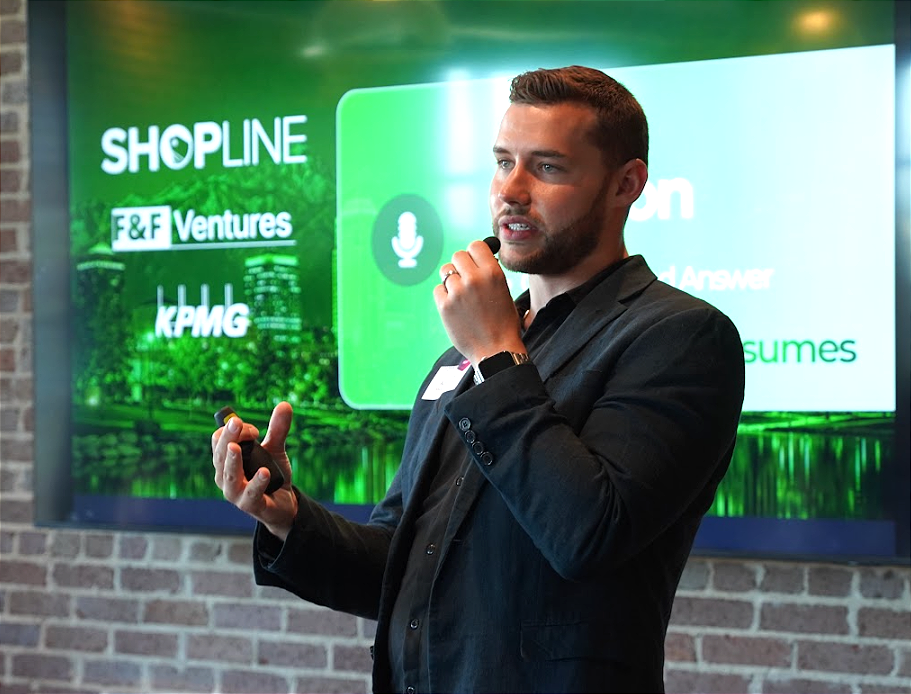
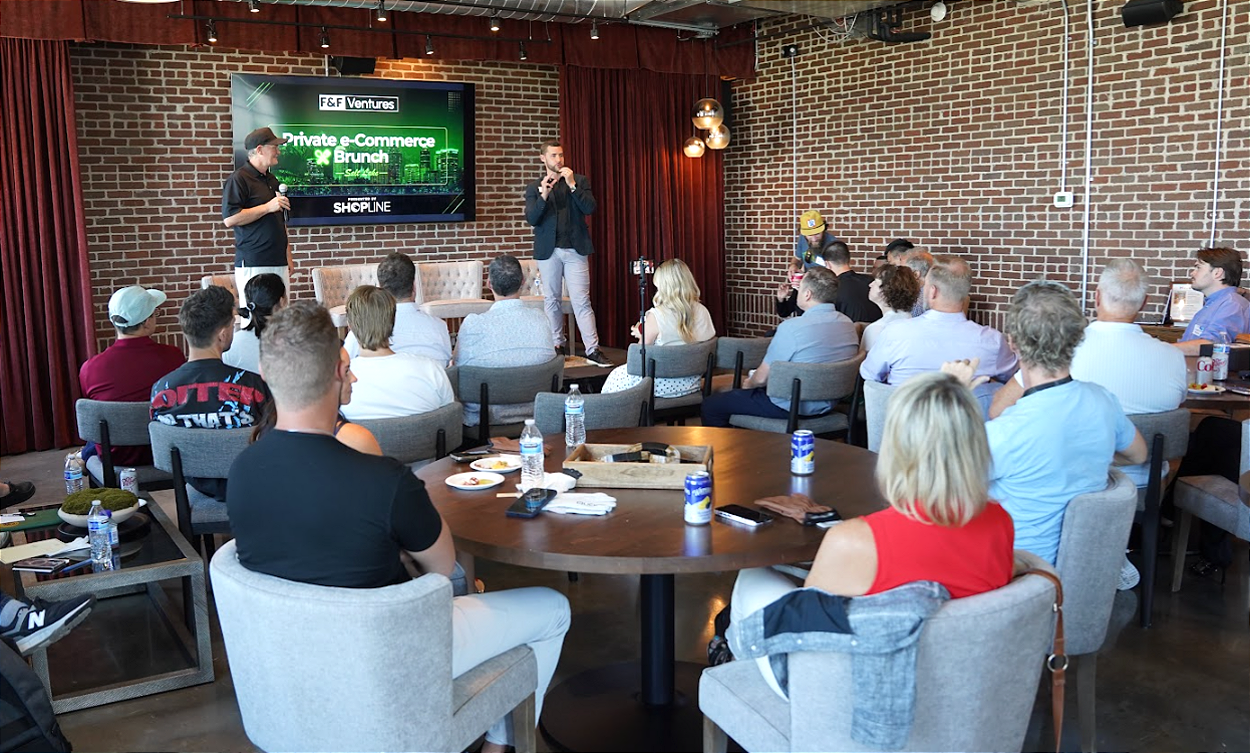
Adam Shaw, speaking to the audience at the Founders & Funders' eCommerce Brunch, HVN, Salt Lake City, August 19, 2026. Photo: Mark Tullis, TechBuzz
Adam Shaw, speaking to the audience at the Founders & Funders' eCommerce Brunch, HVN, Salt Lake City, August 19, 2026. Photo: Mark Tullis, TechBuzz
Salt Lake City, Utah — August 28, 2026
Adam Shaw was 11 years old the first time he knew he was an entrepreneur. Working as a paintball referee outside Portland, Oregon, for about five dollars an hour, he did the math on what the range was charging customers and made his boss an offer: skip the wage, pay him ten dollars for every person he brought in instead. Bring ten friends, paintball's free. Within weeks, Shaw says, he realized he was out-earning the owner.
"I learned that I had a drive to figure it out for myself," Shaw said. "Really thinking strategically, and utilizing and working with people to benefit them."
That instinct — find the margin, build the relationship, bet on yourself — has carried Shaw from Woodland, Washington, a small town an hour's drive from Portland, through a medical-supply company he scaled as a college student from zero to $18 million during the pandemic, a management-consulting stint that helped restructure procurement for a group of major REITs, and now into the role of co-founder and partner at Founders & Funders™, the Utah-born venture and events company he now runs alongside Jeff Erickson.
Learning the value of money early
Shaw's account of his childhood is less a straight line than a series of side hustles stacked on top of each other. Money, he said, was never abstract growing up; he understood the value of money early on. By eight or nine, he was already looking for ways to earn his own money. By 13, he was running an Amway operation out of his parents' living room, pulling in teachers and gym acquaintances for pitch nights. By 16, he had enrolled in college classes, largely online, so he could keep building.
"I always had this drive of building relationships with successful business owners even though I didn’t personally know any entrepreneurs," Shaw said, "I had this desire to meet people and get to know them and learn from them.” He took a job at a golf course as a teenager, he said, specifically because it put him in daily contact with business owners he wanted to learn from.
A brain injury reshaped part of that path. Shaw described a ruptured brain concussion from his years playing football, basketball and wrestling that pushed him toward golf instead. He later served a mission in Taiwan, where he became fluent in Mandarin, a skill that would shape the international-trade instincts he'd bring to his first real company.
Zero to $18 million during COVID
Before he set foot on Brigham Young University's campus for its global supply chain program, Shaw had already identified an opening: a pandemic-driven shortage of medical supplies. He built factory relationships in China, then cold-called Army and Air Force procurement offices directly, working with Salt Lake City'sProcurement Technical Assistance Center to get set up onSBA.gov for government contracts. What started as $2,000 and $5,000 orders grew into a company that did roughly $18 million in revenue within about two years, built on a team split between Los Angeles and a factory operation in China.
He was doing it while still enrolled at BYU. "I'd finish a test, fly to New York City," he said. "Everyone is on their own journey. But for me, college was not a time to be social. It was a time to build."
The company eventually exited to a larger East Coast medical distribution company. Shaw doesn't describe it as a triumphant exit. "It wasn't a great exit," he said. "But I learned a lot from what not to do."
Underneath the hustle was a fear he says took years to name out loud: that people would discount him once they learned his age. "My biggest fear was people asking me, 'When did you graduate college? How old are you?'" Shaw said. "If they find out how old I am, they're going to look at me differently. If something goes wrong, they're going to blame my age, not the situation." He now says that fear was self-imposed, and that the people who cared about his age were, by and large, people he didn't want to do business with anyway.
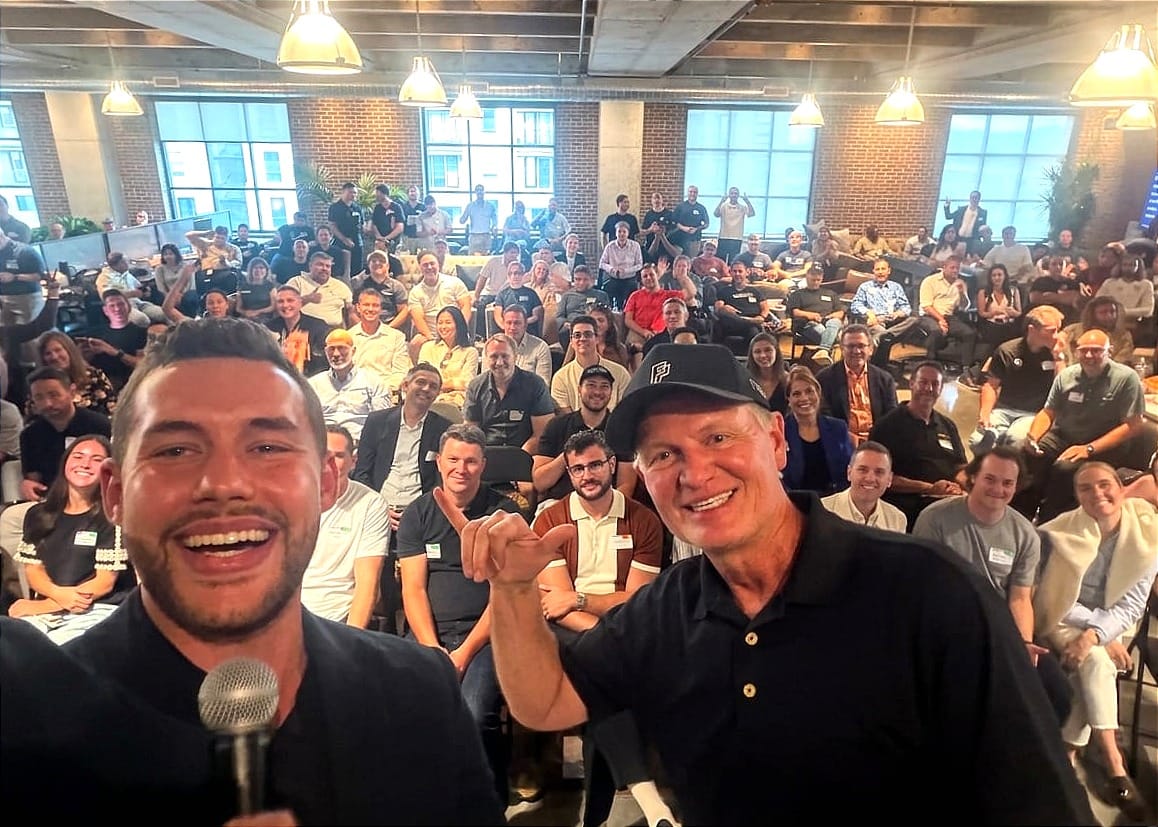
Adam Shaw and Jeff Erickson take a selfie in front of a packed house at Founders & Funders' VC Reverse Pitch at HVN in Salt Lake City. Photo: Mark Tullis, TechBuzz
A costly partnership, and a decision not to fight it
Over the next five years, Shaw worked on several different ventures while based in NYC with offices in Hong Kong, China, and Dubai, including running a 7-figure e-commerce and retail brand. He learned several hard lessons during this time, including the cost of divided attention and the serious repercussions of having the wrong business partner.
Shaw and his wife made the difficult decision to step away from his business partner and the revenue generating companies. Instead of focusing on the negative, they resolved to bet on themselves and focus on where opportunities lied.
While traveling domestically and internationally exploring which opportunity to pursue, Shaw and his wife felt compelled to spend some time in Utah. With a goal to build his network, Shaw compiled a list of people to meet, one of those being Jeff Erickson.
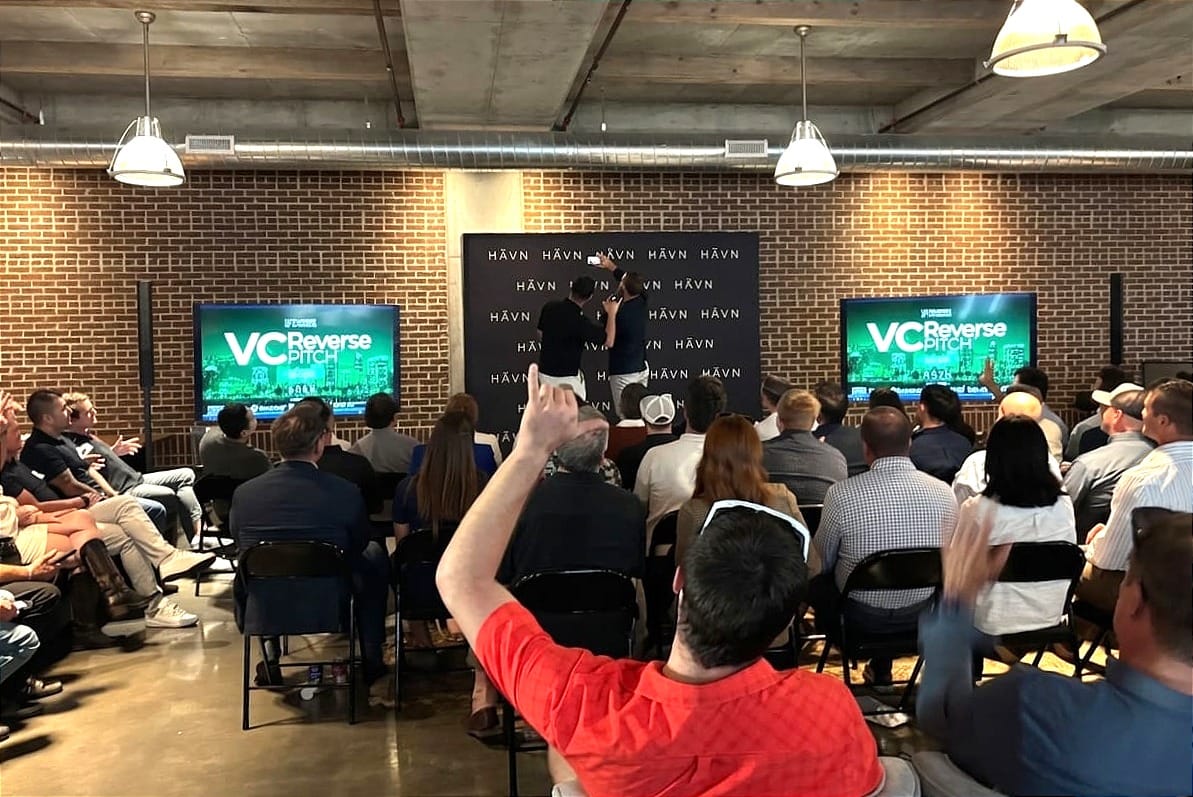
Adam Shaw and Jeff Erickson onstage taking a selfie in front of a packed house at Founders & Funders' VC Reverse Pitch at HVN in Salt Lake City. Photo: Satwik Chavakula, TechBuzz
The Founders & Funders origin story
Shaw's entry point was almost incidental. A friend, Kalvin Richan connected him to Erickson, and Shaw attended a Founders & Funders™ event at Kiln Lehi during Silicon Slopes Summit week. "This is exactly what I want," Shaw said. "I want to build in-person relationships." With Shaw headed back to NYC and Erickson’s busy schedule, there was little time to talk but the stars aligned and they ended up atSlackwater Pizzeria with Erickson’s wife and business partner, Inger.
Founders & Funders™ had started as something closer to a side project. Erickson, early at a company eShares, which later became Carta, had launched the event series in part to help drive sales for the company, pairing venture capital investors with founders in a room. Inger Erickson later stepped in as CEO and helped grow it into a structured event series with sponsors and a system behind it.
Coming in first as a consultant, Shaw began by bringing his own team over to help scale and restructure Founders & Funders™. Inger was ready to step back from day-to-day operations, so as Shaw began driving growth, Inger and Jeff trusted Shaw to come in as CEO and Co-founder.
"Inger built an incredible foundation which allowed me to see the opportunity to come and scale Founders & Funders™," Shaw said. " I am grateful that she trusted me to come on and be the person that they needed me to be. I take that very seriously."
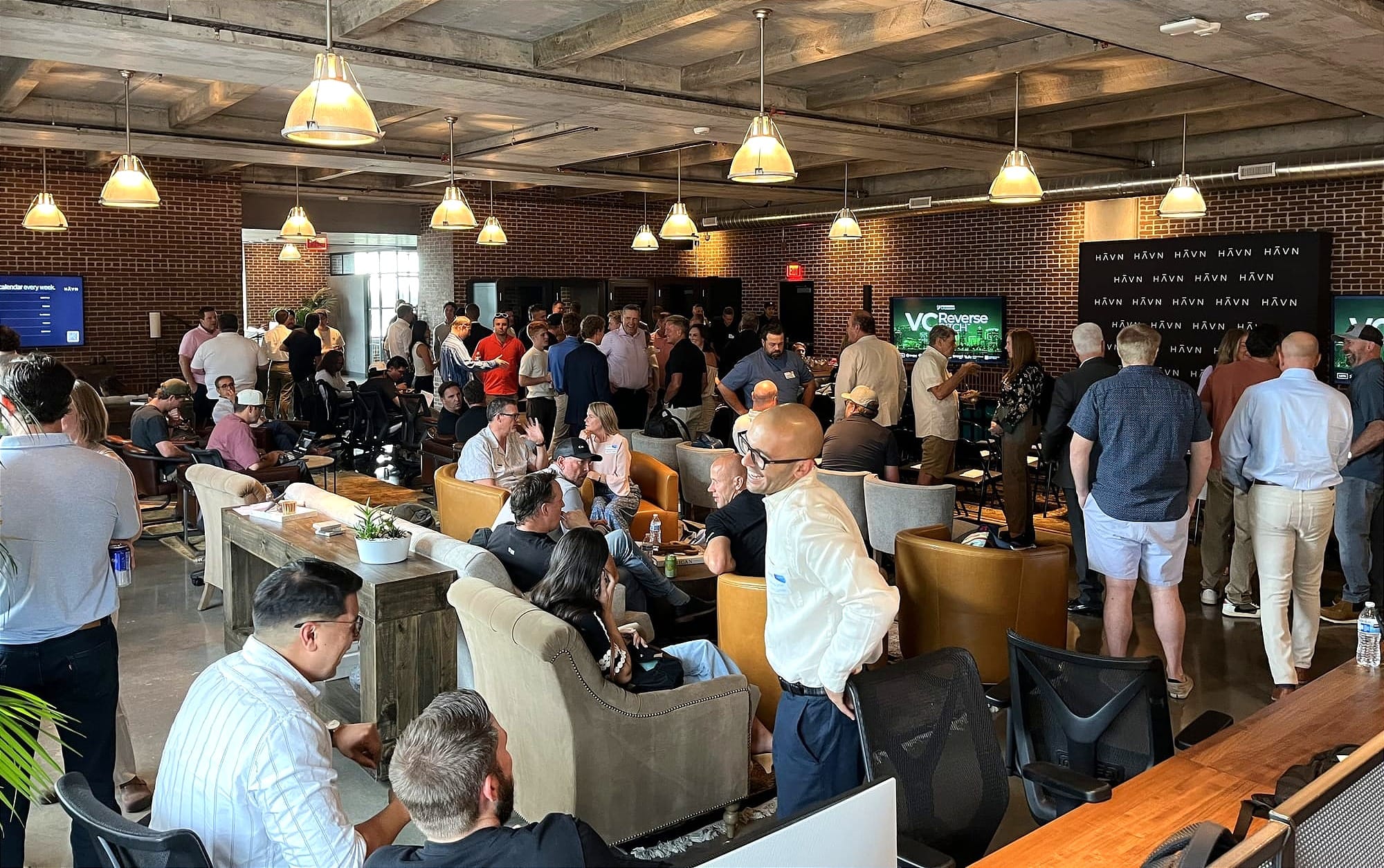
Founders & Funders' VC Reverse Pitch drew roughly 170 people to HĀVN in Salt Lake City — a packed house of founders, investors and operators trading ideas. Great energy in the room for another sold-out Utah edition of the Reverse Pitch series. Photo: Stevie Ibarra
A shifting Silicon Slopes
The timing is notable. Domo agreed in July tosell its core business to Progress Software for roughly $400 million, and Weavefollowed with a $650 million take-private deal with Francisco Partners — two long-standing Utah software names exiting the public markets in the same summer. At Founders & Funders™' own Salt Lake City VC ReversePitch on August 19, 2026, seven venture firms took the stage to tell 120+ hand-picked founders what they're looking for next, and the pattern that emerged leaned toward vertical, industry-specific AI tools and consumer brands rather than the horizontal B2B SaaS that defined the last era of Silicon Slopes. It's the same lane Shaw and Erickson have staked out with F&F Ventures' consumer-goods and e-commerce thesis. It positions the fund at the center of where several other investors in the room said they were headed too.
A recurring room: the eCommerce brunch
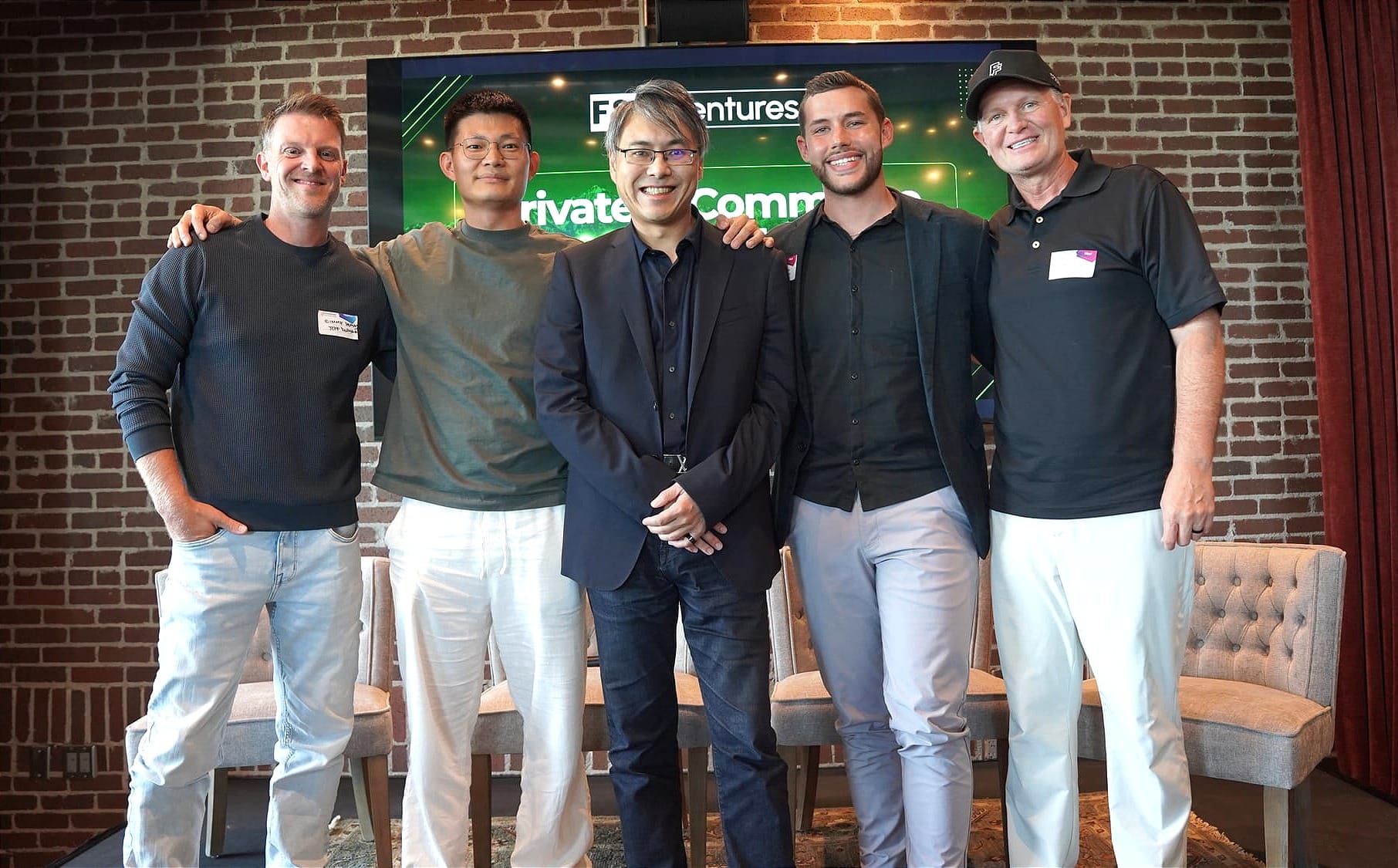
The consumer-goods thesis shows up outside the big ReversePitch format too. Founders & Funders™ — founded in Utah in 2019 — recently hosted an eCommerce brunch in Salt Lake City on August 19, presented byShopline, attended by 60 fast growing Utah-based e-commerce brands. Shaw moderated a panel featuring Jeff Durham ofGimme Beauty, Shopline's Christopher Yang, and Jian Tam, with the conversation centering on a theme the firm returns to often: understanding the customer isn't a box founders check once, and it gets harder to skip the deeper a brand moves into retail and e-commerce. The team has described Salt Lake City as one of its favorite rooms to fill, and says it plans to bring more events back to Utah.
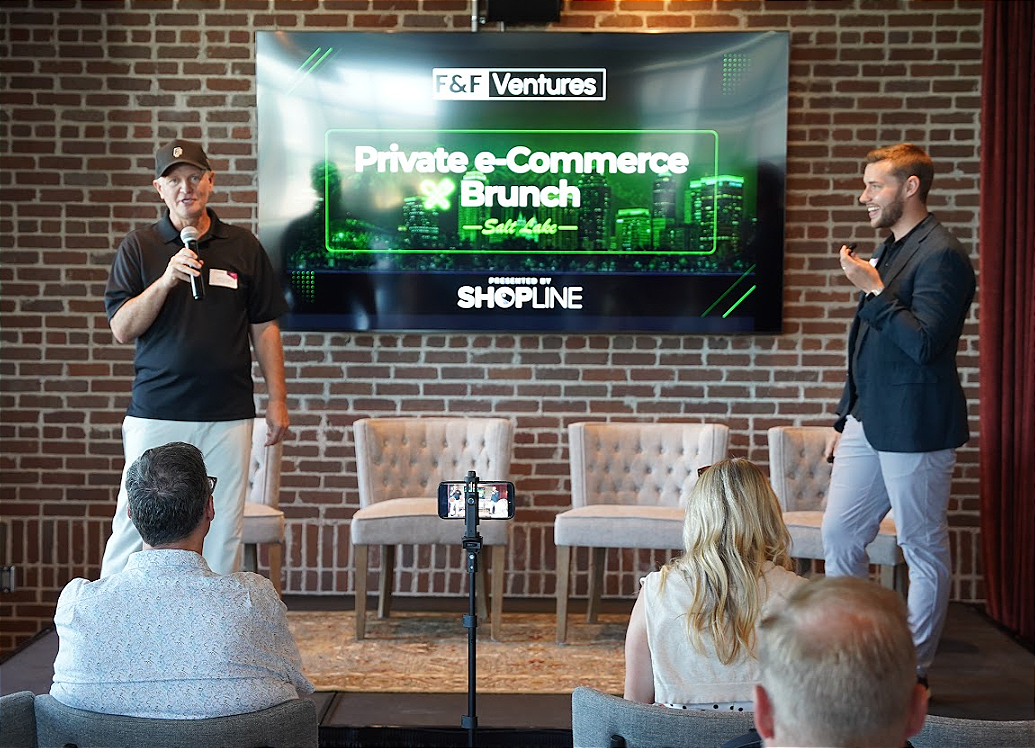
Jeff Erickson and Adam Shaw, onstage at the Founders & Funders' eCommerce Brunch, HVN, Salt Lake City, August 19, 2026. Photo: Mark Tullis, TechBuzz
Building a four-part company
Building a four-part company
Under Shaw and Erickson, Founders & Funders™ has expanded well past its original event series format. The company has now established themselves as the relationship engine for venture, centered around four connected "engines":
Events — anchored by the VC ReversePitch format, which flips the traditional dynamic by having six to eight actively deploying VCs pitch a curated room of 100-plus founders, rather than the reverse. Additional events include e-commerce brunches, VC dinners, and other VIP events. The company says it will run roughly 35 VC Reverse Pitch™ events this year across cities including San Francisco, Austin, New York and London.
Media — a growing content and social team producing interviews and coverage of the venture ecosystem.
Platform — a data layer tracking founder fundraising history, revenue and traction to better match founders with the right investors and partners.
Venture — the firm's investing arm, which Shaw describes as the newest and most structurally important piece.
Shaw, Erickson and general partner Jian Tam now run the venture side together. Tam brings e-commerce operating experience, including two prior exits and a current consumer brand,Protein Waffles — a Brooklyn-based, keto-friendly, gluten- and soy-free waffle line sold direct-to-consumer nationwide.
"Venture capital is not just Silicon Valley money and building a billion-dollar company," Shaw said. "There's so many pieces to it. Our mission is providing the tools, the capital and the relationships to increase founders' likelihood of success."
Jeff Durham (Gimme Beauty), Jian Tam (Protein Waffles), Christopher Yang (Shopline), Adam Shaw (Founders & Funders) and Jeff Erickson (Founders & Funders), after their panel at the Founders & Funders' eCommerce Brunch, HVN, Salt Lake City, August 19, 2026. Photo: Mark Tullis, TechBuzz
"Venture capital is not just Silicon Valley money and building a billion-dollar company," Shaw said. "There's so many pieces of that. Our mission is providing the tools, the capital and the relationships to increase founders' likelihood of success."
The fund, and the Shopline bet
Founders & Funders™' venture arm launched with a $10 million fund with the e-commerce platform Shopline as their venture partner. The firm's investing arm operates under the name F&F Ventures. Shaw and Erickson used their own August 19 Salt Lake CityReversePitch event at HVN to formally announce the fund's focus on consumer goods and e-commerce — a detail that underscores how tightly the events business and the fund are meant to work together. The firm is now raising a $100 million fund, structured, Shaw says, to address a liquidity problem he sees across traditional 10-year venture fund cycles: portfolio companies that don't need to chase billion-dollar outcomes to return capital to LPs.
Jeff Erickson and Adam Shaw, Founders & Funders' eCommerce Brunch, HVN, Salt Lake City, August 19, 2026. Photo: Mark Tullis, TechBuzz
The investment thesis centers on consumer goods and physical-product companies, with technology investments following through deal flow the firm sees via its own network and event pipeline. A portion of the fund is set aside for short-term financing and purchase-order financing, allowing portfolio companies to fund retail expansion without diluting equity as heavily. Shopline's involvement gives portfolio companies direct access to a dedicated solutions engineer and reduced processing fees, according to Shaw, a structural advantage he argues raises those companies' odds of survival.
The firm has also committed to directing 2% of the fund and 2% of carried interest — both GP and LP — toward what Shaw calls economic-growth opportunities. Shaw cites conversations with one of his most profound early mentors,Eddie Wilson, and his organizationImpact Others, as a key influence on that structure.
"Eddie has had a big impact on my journey and taught me how important it is to be authentic, the importance of delegation,the value of time, and so much more. He has increased my vision about the impact my contributions can have on the world.”
Impact Others sources impact opportunities and builds sustainable businesses around the world, with active projects spanning clean water, orphanage support and small-business development in countries including Ghana, Nigeria, Honduras, India, Egypt, Colombia and Thailand.
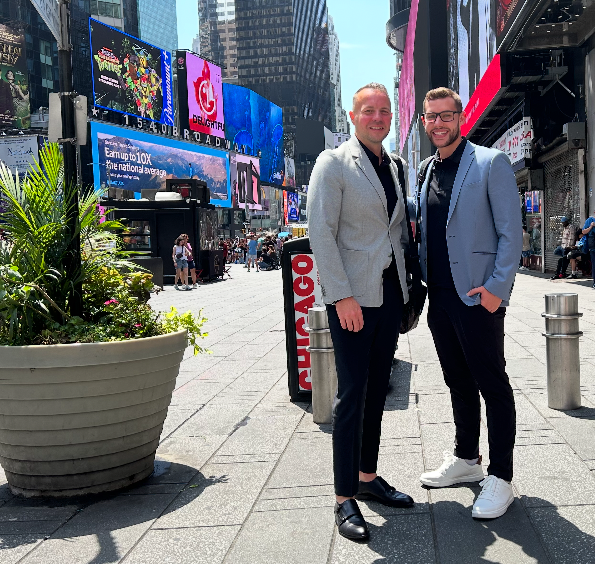
Eddie Wilson and Adam Shaw at Time Square, New York City. Photo: Adam Shaw
Redefining the win
Ask Shaw how he measures success today, and the number he used to chase — a billion-dollar private equity company — pales in comparison to his new perspective."I don't care about the number anymore," he said. "I want to be a good husband, father, and leader while creating an impact."
Shaw and his wife, a fellow BYU global supply chain graduate he credits with getting him through the degree, live in Jersey City with their six-month-old daughter. He describes fatherhood as simultaneously the hardest and most fulfilling thing he's done.
That reframing — success as consistency and authenticity rather than a valuation — is also the note Shaw hits hardest when he talks about mentoring the college students and interns who show up at Founders & Funders™ events. He said he remembers being the kid in the room who wanted access and didn't have it, and that the firm now deliberately makes space for students and early founders inside the same rooms as its VC partners.
"When I was younger, I always dreamed of having a mentor," Shaw said. "So my focus is how do we make sure we create a platform that we can help support current and future founders as much as possible, and support these leaders that want to grow?"
Founders & Funders' next Utah VC ReversePitch is scheduled for New York City on Sep 10, 2025. Learn more at foundersnfunders.com.
Share this article
The link has been copied!
Your link has expired. Please request a new one.
Your link has expired. Please request a new one.
Your link has expired. Please request a new one.
Great! You've successfully signed up.
Great! You've successfully signed up.
Welcome back! You've successfully signed in.
Success! You now have access to additional content.