Torus Launches Foundry, Raises $500 Million to Connect Energy Infrastructure and AI Computing
Torus is entering the AI infrastructure market with Foundry, a modular computing platform that combines power management, energy storage, cooling, networking, and GPUs. The company also announced $500 million in growth capital led by Magnetar to expand manufacturing and accelerate deployments.
Torus's GigaOne manufacturing facility in South Salt Lake spans 545,000 square feet and serves as the production center for the company's expanding energy storage and AI infrastructure businesses. Photo: Ken Hovley, Torus
Torus's GigaOne manufacturing facility in South Salt Lake spans 545,000 square feet and serves as the production center for the company's expanding energy storage and AI infrastructure businesses. Photo: Ken Hovley, Torus
South Salt Lake, Utah — November 11, 2026
Torus is expanding into the artificial intelligence infrastructure market with the launch of Foundry, a modular computing platform that combines AI hardware with the company's existing energy storage and management technology.
The strategy brings together two capabilities Torus has spent several years developing. Its Torus Reserve platform uses hybrid battery and flywheel energy storage, along with intelligent power management, to unlock available capacity within existing electrical connections. Foundry puts that capacity to work, delivering AI inference computing at commercial and industrial sites without requiring the construction of conventional data center campuses.
Torus says the integrated system can move from an undeveloped site to operational AI workloads in 12 to 16 weeks. It can also be installed at existing buildings where electrical capacity is available.
The company says Foundry is already deployed, with thousands of GPUs running live workloads for enterprise customers. It has set a target of deploying more than 47,000 GPUs through Foundry installations by the end of 2027.
Alongside the product launch, Torus announced $500 million in growth capital led by Magnetar, with participation from ICONIQ, Origin Ventures, Ridgeline Partners, and Trinity Capital. The financing will support continued development of the company's energy infrastructure and expanded Foundry manufacturing capacity at GigaOne, its 545,000-square-foot manufacturing facility in Salt Lake City.
"Most providers are bringing power to the chips. Foundry brings the chips to power," said Nate Walkingshaw, founder and CEO of Torus.
The distinction reflects the central premise behind Torus's expansion: the next constraint on AI infrastructure may not be the availability of computing hardware, but the ability to power it. Rather than waiting years for new electrical infrastructure, Torus is betting that existing grid capacity can support a substantial portion of the industry's growing inference demand.
Bringing AI computing to available power
Foundry combines computing hardware, energy storage, power management, cooling, and networking into prefabricated modular systems. Each installation is designed to deliver between 1 and 20 megawatts of AI inference capacity, using available electrical capacity at existing commercial and industrial sites.
Torus says a Foundry installation can move from contract to operational AI workloads in 12 to 16 weeks. The company manufactures the systems at its GigaOne facility in South Salt Lake, then transports them to customer locations. Site preparation generally takes about a week, followed by one to two days for installation and commissioning.
Torus declined to disclose the economics of a typical Foundry installation, including deployment costs or expected customer returns. However, the company emphasized that its value proposition centers on reducing the time and infrastructure investment required to bring computing capacity online.
“We’re not sharing unit economics. What I can say is that customers go from contract to token in 12 to 16 weeks, on power the site already has, without waiting years in an interconnection queue or paying for new generation,” the company spokesperson said.
The approach eliminates much of the construction typically associated with conventional data center development.
The timing is important because the AI computing market is evolving. The first major wave of infrastructure investment focused heavily on training large AI models. Increasingly, however, companies need computing capacity to run those models and deliver responses to users, a process known as inference.
Unlike model training, which can involve concentrated periods of intensive computing, inference workloads often operate continuously and serve users in real time. That creates opportunities for smaller, distributed computing installations located closer to businesses and the customers they serve.
McKinsey projects that data center demand associated with AI inference will grow approximately 35% annually through 2030, compared with 22% for training workloads.
Torus believes that distributed infrastructure, deployed at existing commercial and industrial facilities, can provide an alternative to relying exclusively on massive hyperscale data center campuses.
For enterprises, the model also offers potential advantages in security, intellectual property protection, and control over where computing workloads are processed. Foundry's direct deployment option, for example, dedicates single-tenant hardware to an individual customer's workloads.
The energy technology behind Foundry
Foundry's differentiation is not simply its modular design. It is the integration of Torus's existing energy storage and management technology.
Walkingshaw describes the relationship between the two platforms as the foundation of Torus's AI infrastructure strategy. Reserve addresses the energy constraint by making existing electrical capacity more usable, while Foundry converts that capacity into computing resources. Rather than treating energy storage as a backup component for a data center, Torus is integrating power management and computing into a single deployment model.
"Energy infrastructure makes this possible. Foundry puts it to work," Walkingshaw wrote in announcing the launch.
Every Foundry deployment is paired with Torus Reserve, the company's energy storage and management platform. Reserve combines battery storage with inertial-based flywheel technology and sophisticated power management software.
The system is designed to manage the fluctuations associated with high-performance computing loads, allowing a facility to draw power more consistently from its existing electrical interconnection.
AI computing can produce rapidly changing electrical demand. Reserve uses what Torus calls load-shaping recipes — predefined controls that determine how stored energy is dispatched and how loads are managed. The system can provide ramp-rate support, grid flexibility, load curtailment, and rapid-response power.
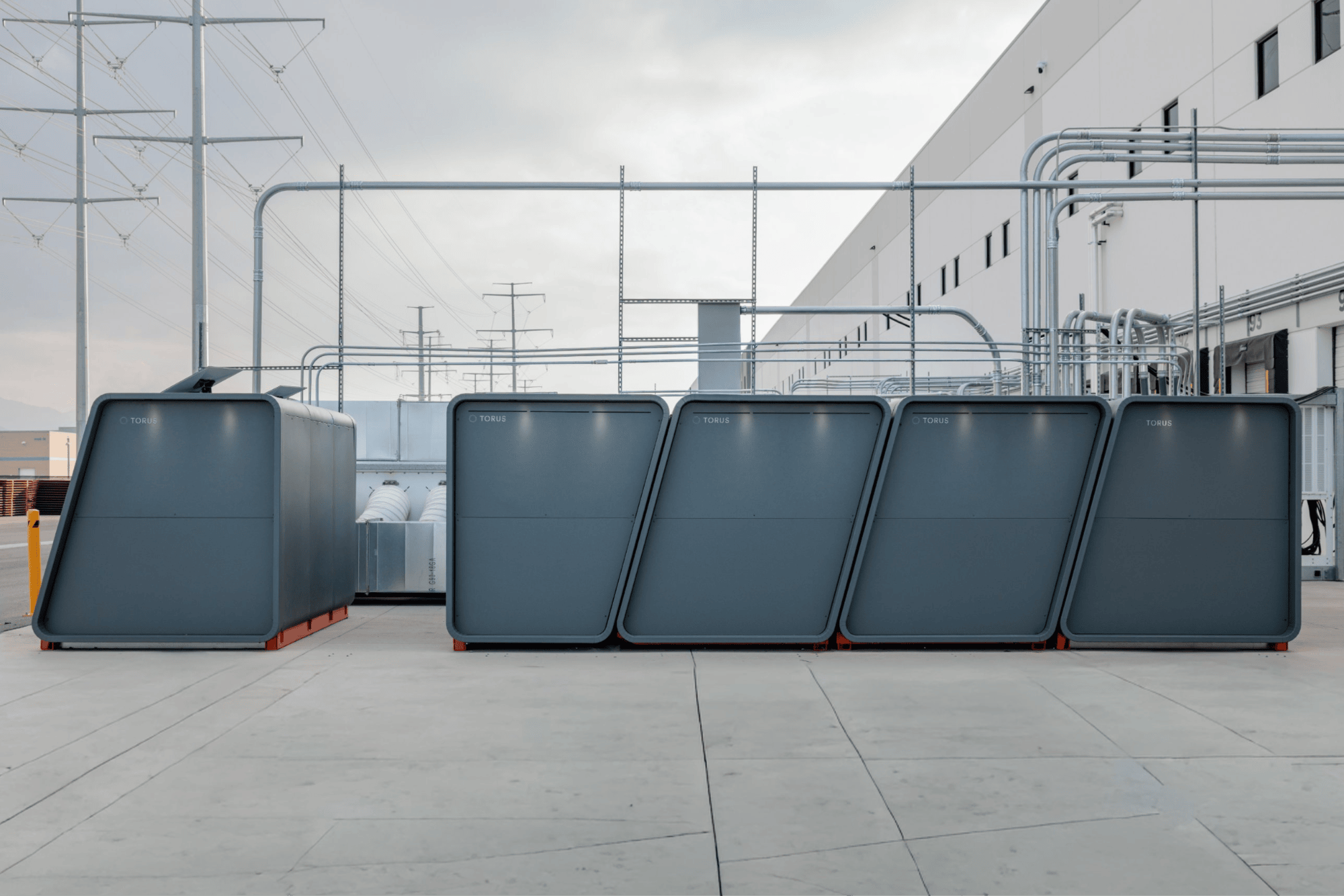
A Torus Foundry installation operates outside GigaOne, Torus’s manufacturing plant in South Salt Lake. The company's Torus Reserve platform combines battery storage, flywheel technology, and intelligent power management to help stabilize electrical loads, provide backup power, and make more effective use of existing grid connections. Nov. 9, 2026. Photo: Ken Hovley, Torus
Integrated flywheel and battery storage can cover demand peaks, potentially allowing more computing capacity to operate within the limits of an existing utility connection. The storage system also provides backup power during grid outages.
Torus installs Foundry behind the meter, meaning the equipment operates on the customer side of the utility's electrical connection. The company targets locations with unused capacity at existing transformers and interconnections.
The underlying premise is that some locations have electrical capacity available that cannot easily be redirected elsewhere because of limitations in the distribution system. Rather than waiting for new generation, transmission lines, or utility upgrades, Torus wants to make better use of capacity already present at those locations.
The company says its approach can add substantial computing demand without requiring the grid infrastructure upgrades commonly associated with new data center development.
That distinction matters as communities and utilities grapple with the costs of accommodating rapidly expanding electricity demand. It also places Torus in a growing market for technologies that help manage the relationship between large electricity users and the grid.
From energy storage to distributed infrastructure
Foundry builds on a business Torus has been developing since its founding in 2021.
The company began in Springville, Utah, with a focus on energy storage and management. Its original residential product, Torus Station, combined energy storage, solar integration, and software designed to give homeowners greater control over their electricity use.
As the company matured, it increasingly shifted toward commercial, industrial, and utility-scale applications.
In May 2024, TechBuzz covered the grand opening of Torus's manufacturing facility in South Salt Lake, a 44,000-square-foot headquarters and manufacturing operation where the company demonstrated its flywheel and battery storage technologies, commercial energy management systems, and participation in utility programs. Earlier that year, Torus had announced a $67 million financing round to support the expansion of its energy storage and management platform.
In February 2025, Torus announced a partnership with Rocky Mountain Power to integrate its storage technology into the Wattsmart Battery program. The initial initiative contemplated up to 70 megawatts of demand-response capacity, with the potential to strengthen grid reliability while expanding the utility's distributed energy resources.
The company's ambitions grew substantially in September 2025, when Torus announced a $200 million investment from Magnetar to scale its distributed power infrastructure business. That financing supported the expansion of manufacturing, utility partnerships, and deployments serving commercial and industrial customers, including facilities with significant power requirements.
The company also outlined plans for GigaOne, a substantially larger manufacturing operation in Salt Lake City. That facility is now central to Torus's next phase.
The progression from residential energy storage to commercial power systems, distributed grid infrastructure, and now modular AI computing reflects a broader strategy: developing integrated infrastructure that can generate greater value from the electricity already available.
Walkingshaw has previously described the company's ambition as building a distributed utility, a network of smaller, interconnected power resources capable of delivering services traditionally associated with centralized power plants.
Foundry extends that concept into computing.
GigaOne becomes a manufacturing engine
Foundry will be manufactured at GigaOne, Torus's 545,000-square-foot manufacturing facility in South Salt Lake.
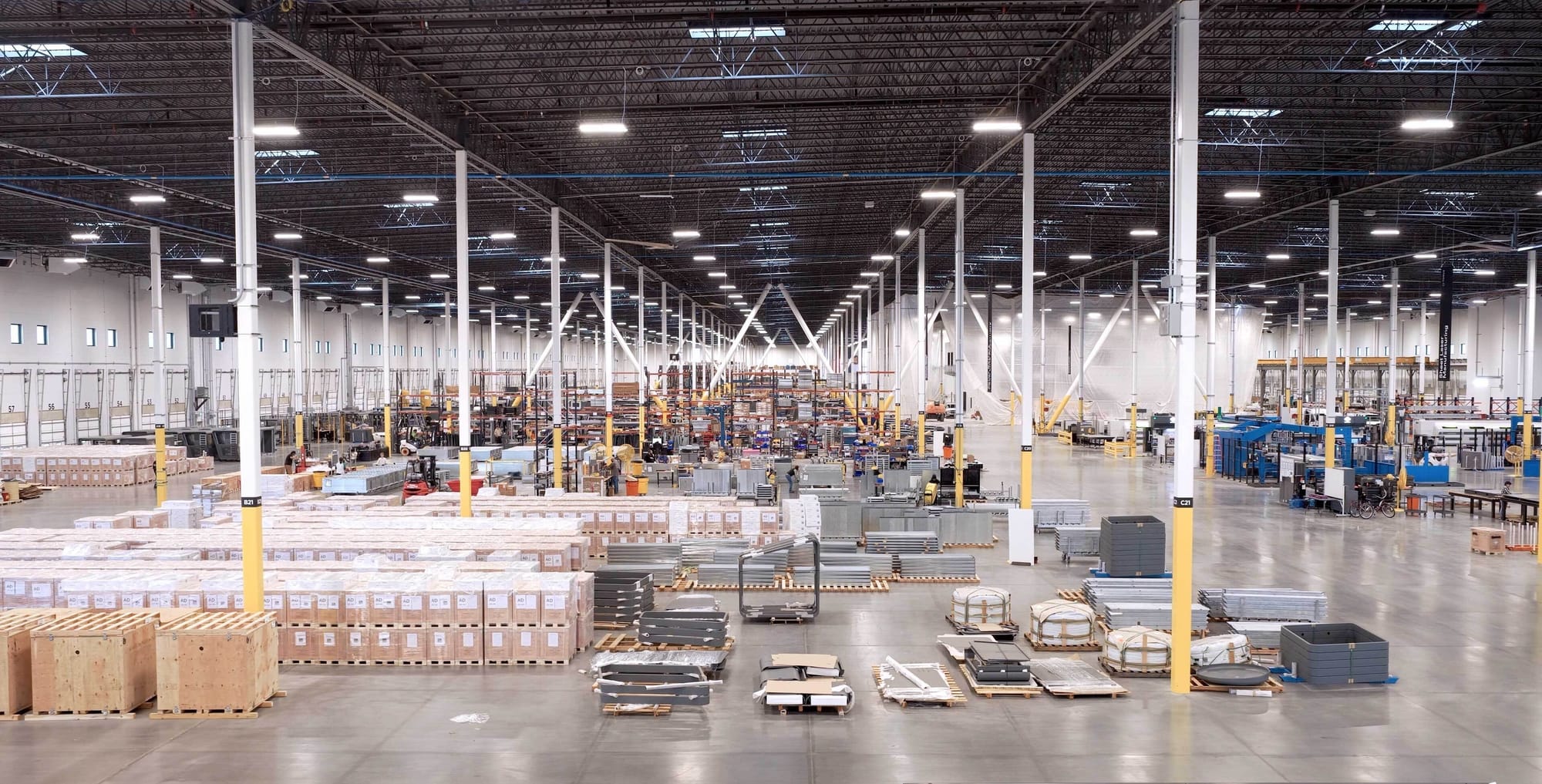
Torus's GigaOne manufacturing facility in South Salt Lake spans 545,000 square feet and serves as the production center for the company's expanding energy storage and AI infrastructure businesses. The facility manufactures key components in-house and is now producing Torus Foundry, the company's modular AI computing platform. Photo: Ken Hovley, Torus
The facility represents a major expansion of the company's domestic manufacturing capabilities. Torus says it opened its first production line in early 2026 and has subsequently brought additional production lines online approximately every 21 days.
The Foundry production line is operational and is designed to reach 500 megawatts of IT load manufacturing capacity, with plans to expand to 1 gigawatt.
The distinction between manufacturing capacity and deployed computing capacity is important: these figures describe the production capability Torus is building, not the amount of Foundry capacity already operating at customer locations.
The company employs nearly 400 people and says Foundry is designed, engineered, and manufactured in Utah, with key components produced in-house.
That vertical integration is an important part of its strategy. By controlling more of the manufacturing process, Torus aims to reduce supply-chain exposure, accelerate production, and maintain tighter integration between the energy systems and computing infrastructure.
The company has also emphasized domestic sourcing and manufacturing as part of its broader energy-security mission.
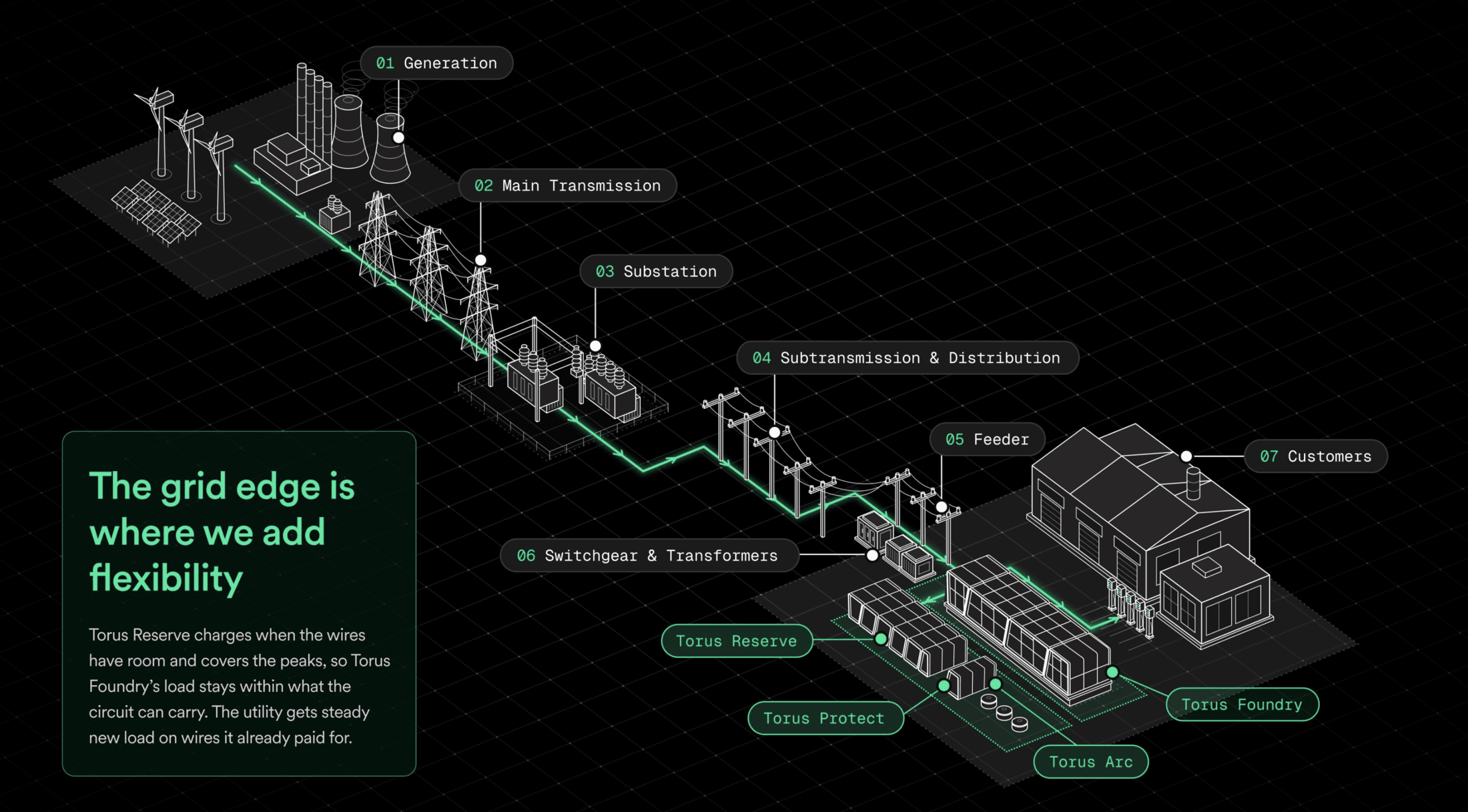
Foundry is installed at the customer’s site, where an existing commercial or industrial facility connects to the grid. Torus Reserve stores energy when the local wires have room to spare and supplies it during demand peaks, so the site stays within what its existing utility connection can carry. (Graphic: Torus)
Three ways to deploy Foundry
Torus is expanding its business beyond energy infrastructure into AI computing, while maintaining a model that gives customers different levels of participation and control over the infrastructure.
The company says it will continue building and owning energy infrastructure while adding AI infrastructure through Foundry. Its three deployment models accommodate customers who want to supply their own GPUs, those seeking turnkey computing infrastructure, and enterprises that want dedicated inference capacity.
Regardless of the deployment model, Torus remains responsible for ongoing operations and maintenance (O&M) of Foundry installations. The level of operational involvement in the Direct model, which provides dedicated inference capacity to enterprise customers, can be tailored to individual customer requirements.
As the Torus spokesperson explained, Foundry is available in three configurations: a powered shell without GPUs, a turnkey bare-metal unit with GPUs, or sovereign, single-tenant inference capacity provided directly to enterprises. The three models are designed to address different customer requirements and levels of infrastructure involvement:
Strategic provides a powered shell, including the enclosure and power infrastructure, but without GPUs. This model is intended for partners that want to supply their own computing hardware.
Partner delivers a turnkey bare-metal system that includes power infrastructure, enclosure, and GPUs. This allows AI infrastructure providers to deploy computing capacity without independently assembling the entire facility.
Direct provides sovereign inference capacity directly to enterprise customers. The model allocates dedicated, single-tenant hardware to an individual company's workloads, giving customers greater control over their computing environment.
Torus is launching the platform with its first customers, including Hydra Host and another AI cloud provider that the company has not publicly identified.
According to Walkingshaw, Foundry is already operating with thousands of GPUs running live workloads for enterprise customers. That gives the launch a dimension beyond a new product introduction: Torus is bringing an existing, operational platform to market and now intends to scale its deployment nationally.
That target would represent a substantial expansion of the company's role in the AI infrastructure market, moving it beyond providing power systems to becoming an operator and manufacturer of computing infrastructure itself.
A $500 million bet on the next phase
Magnetar Capital, headquartered in Evanston, Illinois, led the financing. Its $200 million investment in 2025 helped fund the expansion of Torus's distributed energy infrastructure business and the development of GigaOne.
Alongside Magnetar, the financing brings together investors with headquarters and operations in several major U.S. investment centers, including ICONIQ Capital (San Francisco), Origin Ventures (Chicago, with a Utah office), Ridgeline Partners (with offices in Memphis, San Francisco, Washington, D.C., and Los Angeles), and Trinity Capital (Phoenix).
Torus has not disclosed how the $500 million will be divided between manufacturing expansion and customer deployments. A company spokesperson shared with TechBuzz that the capital is intended to accomplish both: increasing production capacity at GigaOne and accelerating Foundry deployments nationwide.
“We’re not disclosing the allocation, but the money is aimed at two things: scaling manufacturing at GigaOne and taking Foundry nationwide,” said the Torus spokesperson. “Demand is already there. Our focus is getting units to where the power is.”
For Magnetar, the investment reflects the growing importance of energy infrastructure as a prerequisite for AI expansion.
"One of the biggest challenges in scaling AI infrastructure is access to power, and the solution isn't simply generating more of it, but making better use of what's already available," said Dave Snyderman, managing partner and global head of alternative credit and fixed income at Magnetar.
"Foundry builds on that foundation by bringing compute to available power, helping unlock capacity within the existing grid."
The capital will support continued expansion of GigaOne and deployments of Torus Reserve and Foundry across the country.
The funding also gives Torus additional resources to scale manufacturing at a time when demand for AI infrastructure is driving significant investment throughout the technology and energy sectors.
Addressing the environmental footprint of AI
Torus is also emphasizing the environmental characteristics of its modular approach.
Foundry uses a closed-loop cooling system that the company says consumes 95% less water than conventional evaporative cooling systems. Water consumption has become an increasingly important consideration in data center development, particularly in water-constrained regions of the western United States.
The company also argues that deploying computing capacity at locations with existing electrical headroom can reduce the need for new transmission and generation infrastructure associated with conventional data center campuses.
That proposition will ultimately depend on the characteristics of individual sites, the available grid capacity, and the actual operating requirements of each installation.
Torus has also incorporated a research component into its sustainability strategy. Each Foundry system will donate GPU computing time to Folding@home, the distributed computing project that uses volunteer computing resources to support medical research.
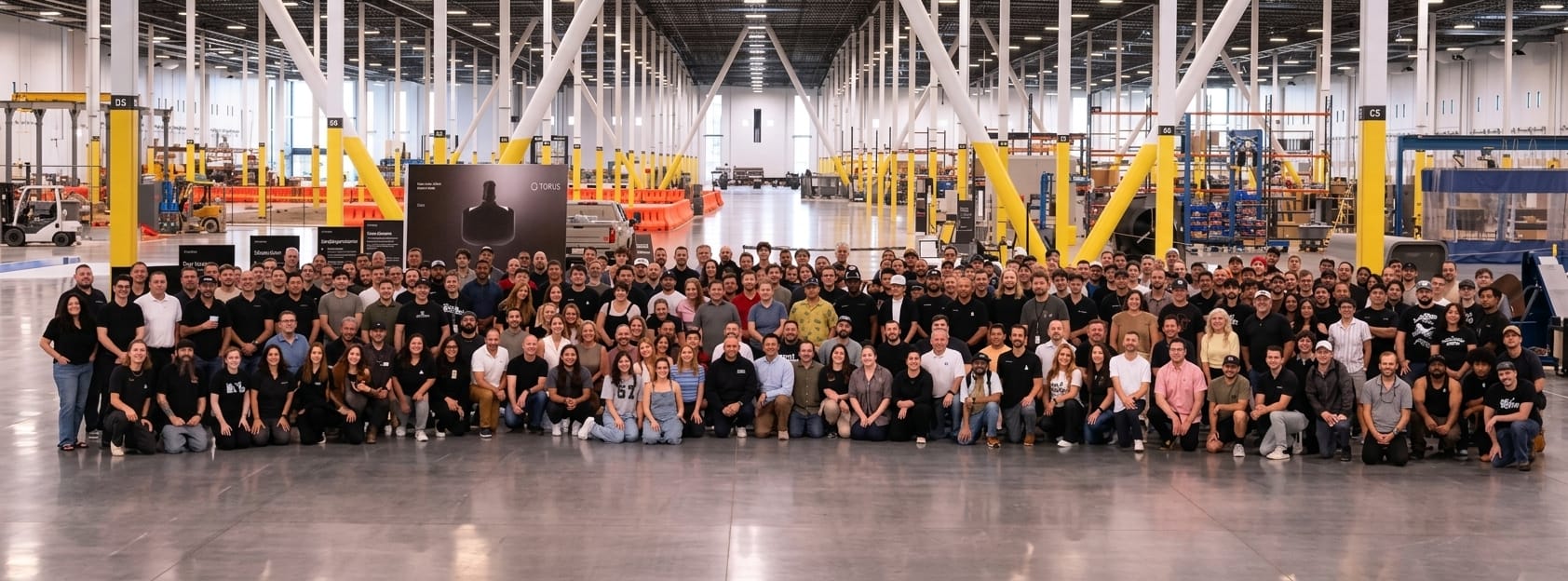
Torus employees at GigaOne, Torus's 545,000-square-foot manufacturing facility in South Salt Lake. Photo: Ken Hovley, Torus
Utah's expanding role in the AI infrastructure economy
Foundry represents a significant new chapter for a Utah company that has steadily expanded its ambitions from energy storage into the broader infrastructure supporting electrification and advanced computing.
It also positions GigaOne as more than an energy-storage manufacturing facility. The plant is becoming a production center for integrated energy and computing systems aimed at a national market.
As AI adoption accelerates, the availability of computing power will increasingly depend on the availability of electrical power, the ability to connect new loads to the grid, and the speed at which infrastructure can be manufactured and deployed.
Torus is betting that these challenges can be addressed together.
Rather than waiting for the next generation of data center campuses and electrical infrastructure to be built, the company wants to deploy computing capacity where the power already exists.
For Utah, the announcement brings together several important elements of the state's technology economy: advanced manufacturing, energy innovation, AI infrastructure, and a growing base of companies seeking to serve national markets from Utah.
The next test will be execution: how quickly Torus can scale production, convert initial customer deployments into a repeatable business, and deliver on its ambitious GPU deployment targets.
With $500 million in new capital, an operating manufacturing line, and its first Foundry customers, Torus is making a substantial bet that the future of AI infrastructure will not be limited to enormous centralized data centers.
Some of it may be built in smaller units, closer to the businesses that need it, and on electrical infrastructure that is already in place.
Learn more at www.torus.co. View video below "Why We Built Foundry":
Share this article
The link has been copied!
Your link has expired. Please request a new one.
Your link has expired. Please request a new one.
Your link has expired. Please request a new one.
Great! You've successfully signed up.
Great! You've successfully signed up.
Welcome back! You've successfully signed in.
Success! You now have access to additional content.