Creekstone Gigasite Powers Utah’s AI Boom with Zeo, BluSky, and Next-Gen Energy Strategies
Creekstone Energy (Salt Lake City, UT) is advancing its Utah Gigasite as a national AI infrastructure hub, partnering with Zeo Energy (New Port Richey, FL) to supply 280 MW of solar-plus-long-duration storage, while exploring multi-source and next-generation nuclear options.
The AI boom isn’t just a software story. It’s an energy story — and Creekstone Energy LLC wants Utah to sit at the center of it.
The Salt Lake City–based developer is advancing its Delta Gigasite in Millard County as a multi-source, AI-ready energy and infrastructure campus designed to scale into the gigawatts. Its latest step: partnering with Zeo Energy to evaluate approximately 280 megawatts of solar generation paired with long-duration energy storage (LDES) to provide firm, behind-the-meter baseload power.
The memorandum of understanding between the companies is non-binding. But strategically, it signals something larger: Creekstone is assembling a diversified energy stack — gas, solar, storage, and potentially nuclear — to meet hyperscale AI demand that is accelerating faster than traditional grid expansion timelines.
Buford Ray Conley, CEO, Creekstone Energy
Creekstone CEO Buford Ray Conley emphasized urgency. "AI workloads are driving unprecedented demand for power. At Creekstone, we plan to deliver over 600MW of baseload power to our Gigasite customers in 2027 in Phase 1 of our project. Our collaboration with Zeo reflects the market urgency of using all available energy sources to rapidly provide baseload power. With solar power and Zeo's long-duration energy storage solution, we plan to significantly expand the amount of clean power we offer our hyperscalers and artificial intelligence data center customers."
Near-Term Scale, Long-Term Vision
Creekstone plans to deliver more than 600MW of baseload power in Phase 1 of the Gigasite by 2027, anchored initially by natural gas. Over time, the site’s ambition stretches far beyond that. The company has outlined a long-range vision of up to 10 gigawatts of non-nuclear generation, supplemented by potential next-generation nuclear capacity under evaluation.
In parallel, Creekstone has signed an agreement with BluSky AI Inc. to provide land and up to 50MW of power for modular AI data center deployments at the site, positioning BluSky as one of the Gigasite’s first major tenants.
That momentum underscores Creekstone’s broader objective: build energy capacity first, attract hyperscale computing next.
Zeo’s proposed 280MW solar-plus-storage system would represent one of the first large-scale renewable firming layers added to that gas backbone.
Zeo’s Strategic Pivot: From Residential to AI
For Zeo, the Gigasite represents more than a single project.
The Florida-based company, headquartered in New Port Richey, expanded its technical capabilities through its acquisition of Heliogen, Inc. (Pasadena), gaining thermal and chemical long-duration storage expertise. Now it is formalizing AI data centers and commercial energy offtakers as a distinct business line.
This is not a pilot. It’s a pivot.
Zeo confirmed it anticipates co-developing the power assets and retaining a minority ownership stake alongside other partners rather than serving solely as an engineering contractor. That structure gives the company long-term economic exposure — but also capital intensity.
Tim Bridgewater, CEO, Zeo Energy Corp
"Our MOU with Creekstone is a milestone in this effort, and we are in discussions with several other projects that we believe can benefit from our clean baseload power solutions," said Salt Lake City-based Bridgewater.
Under the current design assumptions, Zeo expects the Gigasite system to deliver between 10 and 14 hours of storage duration, providing firm, dispatchable capacity suitable for baseload operations.
That duration exceeds the typical four-hour lithium-ion deployments common in grid applications, while stopping short of speculative multi-day storage concepts still in early commercialization.
Zeo argues its thermal and chemical storage systems experience minimal degradation over a projected 30-plus-year lifespan. Lithium-ion systems, by contrast, typically face meaningful capacity fade and shorter operating lifespans.
Detailed round-trip efficiency and capital cost figures remain subject to final system design and have not yet been disclosed. But Zeo is clearly positioning lifecycle durability — not short-term peak shaving — as its competitive differentiator in the AI data center market.
Importantly, the solar-plus-storage system is not intended to replace gas generation in the initial phase. Instead, it would add renewable baseload capacity alongside Creekstone’s planned 300MW-plus gas fleet, strengthening resiliency and emissions performance without compromising dispatch reliability.
Financing: The Real Gate
While permitting, technology validation, and integration studies remain ongoing, Zeo identified financing as the primary hurdle between today’s MOU and a definitive agreement.
Equity investment will be required to meet levelized cost-of-energy targets. Beyond tax equity associated with early phases, the company is evaluating project-level debt, joint ventures, and other structured financing options.
In short: this is a capital markets story as much as an engineering one.
If the initial deployment proves resilient and economically competitive at hyperscale, Zeo believes it could position itself as a long-term baseload partner as the Gigasite scales into multi-gigawatt territory.
But the first project must close, and it must perform.
Nuclear in the 2030s?
Creekstone’s strategy extends beyond solar and storage.
The company has also entered into an MOU with EnergySolutions to evaluate at least 2 gigawatts of next-generation nuclear capacity at the site, targeting a potential 2030–2035 commercial window. That evaluation includes reactor technology screening, regulatory timelines, transmission integration, and cooling infrastructure requirements.
The nuclear exploration does not displace Zeo’s near-term role. Instead, it reinforces Creekstone’s multi-source thesis: immediate buildable capacity today, optionality for advanced clean baseload tomorrow.
In that framing, Zeo’s 280MW deployment becomes an early structural layer in a much larger, decade-long infrastructure buildout.
Utah as an Energy Innovation Corridor
Utah is increasingly becoming a proving ground for scalable power solutions.
Recent municipal projects, such as UMPA’s 48MW Nephi facility using modular linear generator technology, featured recently in TechBuzz, demonstrate how utilities are turning to flexible, dispatchable generation to avoid transmission bottlenecks and interconnection delays. At the Gigasite, the scale is exponentially larger, but the constraint is similar: demand growth is outrunning the grid.
Data center developers are reserving transformers, switchgear, and manufacturing slots across the West. Transmission upgrades trigger multi-year delays and nine-figure price tags. Under those conditions, behind-the-meter generation and multi-source strategies shift from optional to essential.
Creekstone’s Gigasite sits at the intersection of power corridors and fiber routes in the Western grid, giving it geographic advantages. But geography alone doesn’t solve capital discipline, supply chain bottlenecks, or execution risk.
Those challenges now define the race.
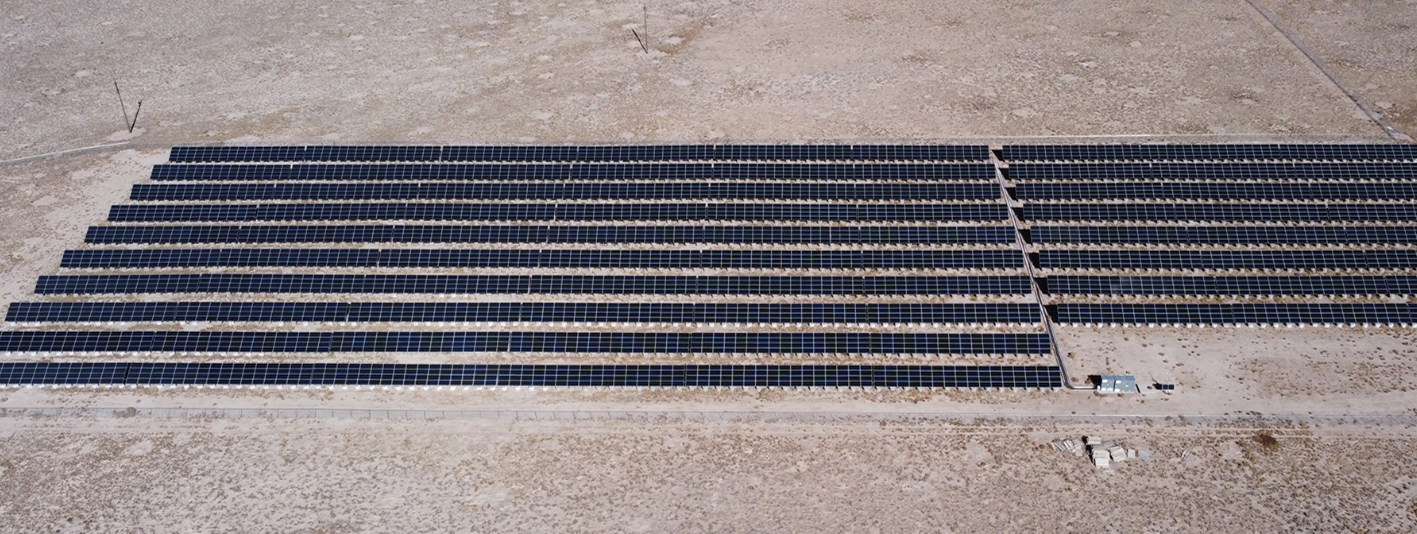
A nearby solar array in Millard County, similar to type envisioned for the Creekstone Gigasite
The Bigger Bet
For Creekstone, the vision is clear: build one of the nation’s most advanced AI-ready energy campuses in rural Utah.
For Zeo, the opportunity is equally consequential: prove that long-duration solar firming can operate as true baseload infrastructure for hyperscale computing.
If the financing aligns and the first deployment performs, the 280MW project could mark the beginning of a new category: durable, renewable-backed baseload purpose-built for AI.
If not, it becomes another ambitious MOU in a market where ambition far exceeds available electrons.
Either way, Millard County is no longer peripheral in the AI race. It is becoming foundational.